
If you work remotely for a company outside Romania, the question that actually matters is not where your salary comes from. It is which country you are a tax resident of, and where your social contributions belong. Get that right, and Romania also happens to be one of the more attractive tax environments in the EU if you set up a company or register as self-employed here.
In short
| Question | Why it matters |
|---|---|
| Where is your tax residency? | Your country of residence can tax your worldwide income, not just what you earn locally. |
| Do you invoice as an individual or through a company? | This changes your tax rate dramatically. See the numbers below. |
| Is your employer or client inside the EU/EEA/Switzerland or outside it? | The A1 rules for social security only apply within the EU/EEA/Switzerland, not automatically for the UK, the US, or elsewhere. |
What Romania actually costs you in tax
This is usually the part people care about most, so here it is directly, with the current 2026 figures rather than outdated ones you may have seen elsewhere.
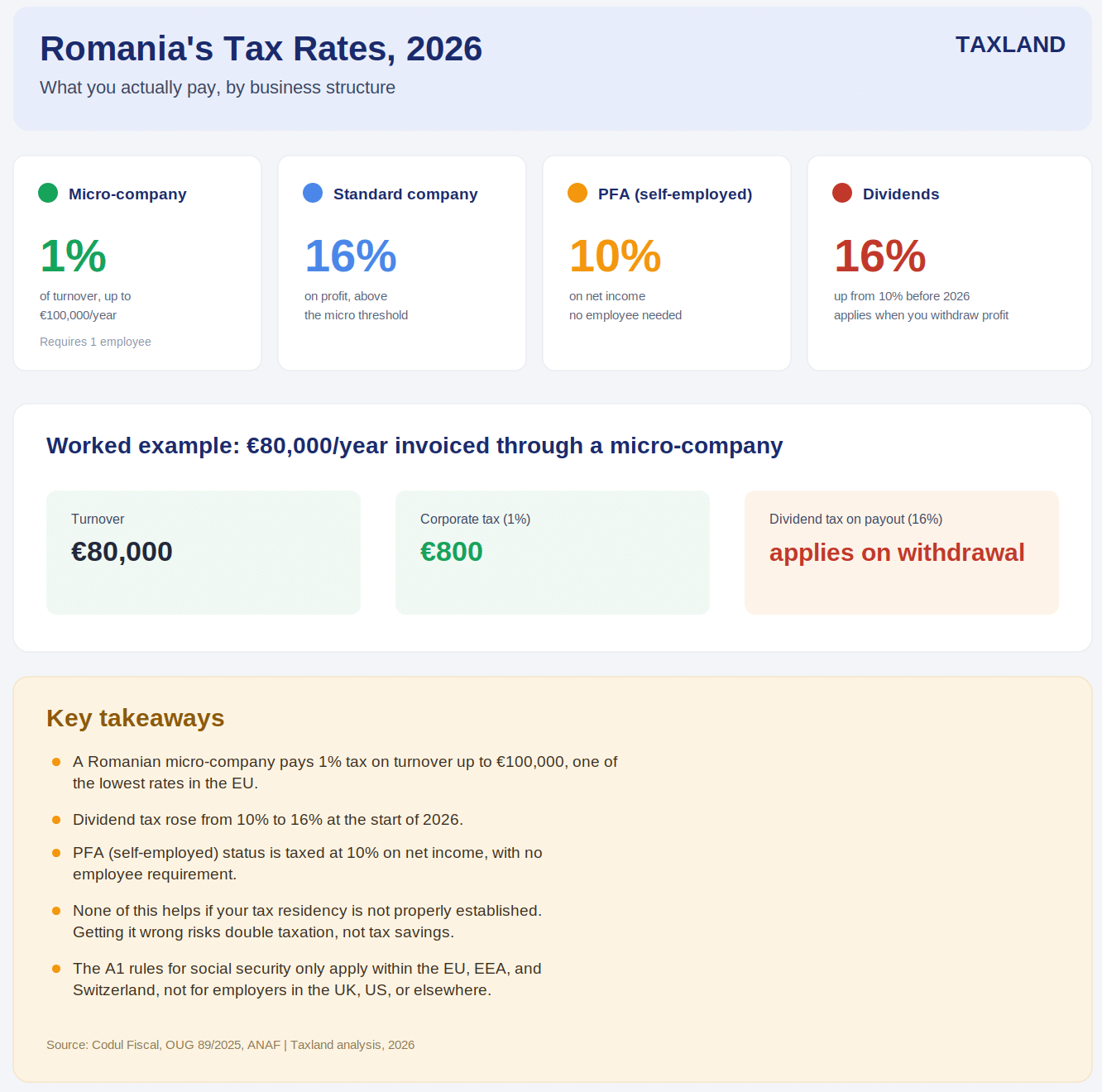
| Structure | Tax rate | Who it fits |
|---|---|---|
| Micro-company (SRL) | 1% on turnover, up to €100,000/year | Freelancers, consultants, small agencies invoicing under €100k. Requires at least one employee or a paid administrator. |
| Standard company (over the micro threshold) | 16% on profit | Once turnover passes €100,000, or if the micro conditions no longer apply. |
| PFA (self-employed individual) | 10% on net income | Solo consultants who would rather not run a company. Simpler setup, no employee requirement. |
| Dividends | 16% | Applies when you take profit out of a company. This went up from 10% at the start of 2026, worth knowing if you read older articles quoting the old rate. |
A concrete example: bill €80,000 a year through a Romanian micro-company, and the corporate tax bill is €800 (1% of turnover). Pay yourself the rest as dividends after covering costs, and you owe 16% on what you take out as dividends. Compare that to running the same income through a standard employment contract in most Western European countries, where combined income tax and social contributions can easily reach 35 to 45%. The gap is real, and it is the main reason freelancers and consultants relocate their invoicing to Romania.
None of this works, though, if your tax residency is not actually settled here. If ANAF and your home country both think they have the right to tax you, you can end up paying twice, or spending far more on penalties and back taxes than you ever saved.
How ANAF decides where you are a tax resident
According to ANAF’s guidance on establishing tax residency, residency is not just about counting days. Several criteria are looked at together.
| Criterion | What gets checked |
|---|---|
| Domicile | Your registered address in Romania |
| Permanent home | A home available to you in Romania, whether owned or rented |
| Centre of vital interests | Family, bank accounts, property, employment or business activity |
| Physical presence | More than 183 days within any 12 consecutive months |
| Double tax treaty | Tie-breaker rules if two countries both claim you as resident |
Spending three months a year in a Bucharest coworking space does not make you a Romanian tax resident on its own. What actually counts is registering formally, filing the residency questionnaire, and making sure your personal and economic ties genuinely point here, family, bank accounts, and address included.
If your employer is outside the EU
The A1 certificate and the EU rules on social security coordination only apply within the EU, EEA, and Switzerland. If your employer or main client is in the UK, the US, or anywhere else outside that zone, your obligations depend on bilateral agreements and how the work is structured, not on the A1 system. This is exactly the kind of case worth checking before you commit to a structure, not after.
What can go wrong
| Risk | What prevents it |
|---|---|
| Double taxation, taxed both in Romania and your previous country | A properly filed residency questionnaire and a certificate of tax residency |
| Losing eligibility for the micro-company regime without noticing | Tracking the €100,000 turnover threshold and the employee requirement |
| ANAF questioning income earned abroad | A complete tax file and explanations prepared in advance, not after a notice arrives |
| Choosing the wrong structure (PFA vs. micro-company vs. standard company) | A review of your income level and business plan before registering anything |
Two real scenarios
A developer billing a German company €70,000 a year. Set up correctly as a Romanian micro-company with tax residency properly established, the corporate tax bill is €700. Set up carelessly, with residency left ambiguous and no A1 or treaty documentation, the same person can end up owing tax in both countries at once.
A consultant moving from the Netherlands, keeping Dutch clients. The work does not change. What changes is where the income is taxed, and that depends entirely on whether Dutch and Romanian ties are documented correctly from day one, not assumed to sort themselves out.
Documents worth having ready
| Document | When it matters |
|---|---|
| ANAF residency questionnaire | When you move to Romania, or leave your previous country for more than 183 days |
| Certificate of tax residency | To prove your residency to a foreign tax authority or client |
| A1 certificate | When working out which EU/EEA/Swiss country your social contributions belong to |
| Company or PFA registration documents | Before you start invoicing under either structure |
The main points
- A Romanian micro-company pays 1% tax on turnover up to €100,000, one of the lowest rates in the EU.
- Dividend tax rose to 16% at the start of 2026, still competitive, but worth knowing before you run the numbers.
- None of this helps if your tax residency is not properly established here. Get that wrong and you risk paying tax twice, not less.
- The A1 rules for social security only apply within the EU, EEA, and Switzerland.
- Choosing between PFA, micro-company, and standard company depends on your income level and how you plan to grow, not a one-size-fits-all answer.
Get a personal assessment
If you are considering Romania for its tax rates, or you have already moved here and need your residency and company structure sorted out properly, we can walk you through the numbers for your specific situation and handle the paperwork.
Write to us at office@taxland.ro and we will get back to you with the practical steps for your case.
Note: this article is for general information and reflects Romanian tax rules as of 2026. Every case needs to be reviewed individually, based on your country of origin, your income level, and how your work is structured.